
OptimaSolar Worblental – A Cooperative Success Story in Renewable Energy
In the world of renewable energy, there are projects that not only have a positive environmental impact but also strengthen the community. One such inspiring project is the Utzigenrain development, carried out by the OptimaSolar Worblental energy cooperative. Their approach involves not only generating CO2-free electricity using a photovoltaic system on the two parking terrace roofs but also selling the locally generated solar power to the property owners. This case study offers insight into the success story of a cooperatively organized initiative that combines innovation and sustainability while also improving the financial situation of the property owners.
The Utzigenrain development comprises a total of 50 condominiums. In 2016, a photovoltaic system covering an area of approximately 550 m² was installed on the two parking terrace roofs. The system was financed through shares purchased by 25 members of the OptimaSolar Worblental cooperative.
CSC-Participants
The Utzigenrain Homeowners' Association (EGU) formed a self-consumption cooperative (CSC) as soon as possible.
Optimizations
- Water Heaters & Electric Charging Stations
- Designed by Gerber AG Energietechnik
- with systems from smart-me and Loxone
Photovoltaic System
- Solar panel area: 550 m²
- Annual production: 91,590 kWh
- Installed capacity: 97.44 kWp
- Investment costs: CHF 190,000
OptimaSolar Cooperative Members
Twenty-five members of the OptimaSolar Worblental energy cooperative contributed to the financing of the solar power system.

Paul Althaus
Co-founder of the OptimaSolar cooperative
By joining the cooperative, each individual can help shape the energy transition while also earning a return on their investment. Members of the cooperative receive a share in the cooperative’s success. The annual interest paid (similar to a dividend) on the share certificate is based on the cooperative’s financial results and is determined anew each year in accordance with a resolution by the board of directors.
Challenge: Reducing the " peak load(s) "
Before 2018, the technology for self-consumption cooperatives (CSC) was still in its infancy and was not legally regulated; for example, private smart meters could not yet be used for metering under tariff models. On May 21, 2017, Swiss voters approved the revised Energy Act. Its purpose is to reduce energy consumption, increase energy efficiency, and promote renewable energy. This paved the way for a “self-consumption community,” as it was still called at the time, and Paul Althaus explored various options for implementation. Paul Althaus explains: “Optimizing self-consumption requires the use of advanced energy management systems and smart technologies. Until a few years ago, there were hardly any solutions in this area. I lacked the real-time data needed to make optimal use of the PV system.” As project manager, Paul Althaus recognized that the key was to efficiently control high-power consumers—such as electric water heaters and the new charging stations—in order to increase self-consumption and, thereby, cost-effectiveness.
One urgent priority is the implementation of peak shaving. When residents of the complex use energy-intensive appliances such as electric stoves, heaters, or air conditioners at the same time, this leads to high electricity demand. Due to high peak loads, the homeowners’ association is forced to pay approximately CHF 700 per month to the energy provider. The grid balance (see chart) clearly illustrates how peak loads are caused by the activation of the water heater groups. The water heater charging process has already been somewhat optimized, as the BKW control system has divided it into four groups. This problem will be further exacerbated in the future by electric mobility, as the simultaneous charging of multiple electric vehicles can cause even higher peak loads.

Approach to a Solution
Integrating electric charging stations and water heaters into the development’s energy management system requires careful planning and configuration to achieve the best possible results. In addition, billing for 50 apartments—particularly responding to customer inquiries—is relatively time-consuming. For this reason, Gerber AG Energietechniktook over the Utzigenrain property effective January 1, 2023. The company handles billing, conducts periodic system inspections, and provides recommendations for optimizing self-consumption.
The metering concept took into account not only the meters for the individual apartments, but also the photovoltaic system, the electric vehicle charging stations, and the water heaters. The first MID meters from smart-me AG were successfully integrated into the project in 2018. To manage peak loads and maximize self-consumption, the project utilizes the intelligent energy management system from smart-me, flexible rate models in smart-me Billing, and (as of the end of 2023) the load control system from Loxone. These systems help distribute and optimize electricity consumption to prevent overloads and thereby reduce electricity costs for residents.
Peak Shaving and Smart Load Management
The most common strategy for increasing self-consumption is to control hot water production. However, every apartment in Utzigenrain has its own water heater, which makes optimization complex. Not only must current PV production and the water heaters’ electricity demand be taken into account, but logic must also be developed to determine when and at what level the water heaters should be activated in order to optimize self-consumption.
While simple optimizations can be implemented using the “If/Then” actions in the smart-me Cloud, a third-party system is recommended for more complex optimizations. The 50 water heaters in the housing development will therefore be controlled using Loxone in the future. When the PV system produces more energy than is currently needed in the households—that is, when a “surplus” is generated—the electric water heaters in the households are used to store hot water. The logic is set up so that the electric heating element of the water heaters is always activated whenever sufficient surplus electricity is available; grid power is used for this purpose only in an emergency. Instead of feeding the surplus electricity back into the grid at an unattractive price, it is now used for hot water production. This increases self-consumption, and the locally generated solar energy is stored in the hot water. Even more important, however, is the reduction in peak load(s) s achieved by the staggered activation of the water heaters, which results in significant cost savings.
The smart-me energy management system continuously monitors current energy generation and consumption. This information is transmitted in real time by Loxone. Loxone then sends control signals to the smart-me meters, which regulate the boilers via their digital outputs. Data is transferred from smart-me to Loxone via an automated API interface and incurs no additional costs.

Markus Streit
Project Manager, Gerber Electrical & Energy Technology
Implementing the boiler control system in this project was an exciting challenge. By precisely coordinating the systems, we were able to not only increase efficiency but also reduce costs. It’s always impressive to see how smart technologies can make a real contribution to sustainability and cost-effectiveness.
The investment in Loxone will pay for itself within 3–4 years. Markus Streit has provided a detailed overview of peak load distribution and the resulting costs on the smart-me web portal. He used this data to demonstrate to the homeowners’ association the cost-effectiveness of further optimizing boiler loads with Loxone.
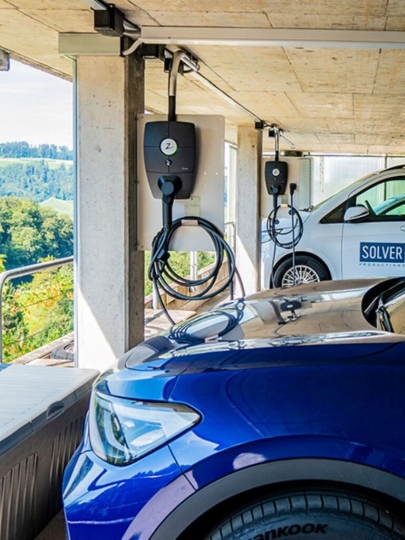
CSC 's electric vehicle charging stations are billed directly through smart-me Billing.
Flexible Rate Plans
Another optimization involves the control of the electric vehicle charging stations. The management (EGU) has provided the basic installation and the ribbon cable, while the owners purchase the individual charging stations. The real-time data gives users precise insight into the charging current currently being used—that is, whether it comes from the PV system or the grid. Since the charging stations are billed at high, low, and solar rates, users have an incentive to charge their cars only when there is a PV surplus. As a result, over 80% of charging is done with locally generated PV electricity. This means that electricity from the PV system is used directly to charge electric vehicles, further reducing the amount of electricity drawn from the grid.
The charging speed of electric vehicles can also be adjusted. The Zaptec charging stations used can be controlled by Loxone at four different levels. If the PV system generates less electricity or electricity consumption in the complex increases, the charging power of the vehicles can be reduced to avoid expensive peak load(s) .
Cooperative Success
By optimizing energy consumption and selling locally generated electricity, the OptimaSolar Worblental photovoltaic system will quickly achieve impressive results. PV generation, self-consumption, and cost savings will increase significantly. The cost savings achieved through peak shaving alone will enable the cooperative to recoup all investments and services provided by Gerber AG Energietechnik within just 5 years.
However, the project is distinguished primarily by its cooperative organizational structure and its pioneering nature. The members of OptimaSolar Worblental invest their own capital to finance systems on leased roofs. Operations are financed through the sale of solar power and other ancillary services. Financial surpluses are used either as profit distributions or for capital repayment. As a result, both the cooperative members and the participants in the self-consumption consortium benefit financially from this project.
““The Utzigenrain photovoltaic system project, which includes on-site electricity consumption (EGU), has exceeded our expectations. We are proud to use locally generated renewable solar power and to contribute to environmental protection. The cooperative organizational structure allows us to invest together in the future of renewable energy and achieve a reasonable return on investment.” – Paul Althaus.
In addition, the Utzigenrain site is being transformed into a “ CSC ” that has been optimally designed by our partner, Gerber AG Energietechnik. Since the solar power generated on-site is used directly within the “ CSC ,” the need for grid electricity is significantly reduced. This lowers participants’ electricity bills, as less electricity needs to be drawn from the grid. This relieves pressure on the power grid, particularly during peak load periods, and contributes to grid stability. In addition, participants reduce their dependence on energy providers and the fluctuations in electricity prices on the market.

Stefan Fischer, Paul Althaus, and Markus Streit (from left to right)
Energy cooperatives are on a growth trajectory
The overarching goal of the OptimaSolar Cooperative is to encourage the public to invest collectively in solar power generation and to meet their own electricity needs with renewable energy. The project continues to grow, and additional cooperatives have already been established in other regions based on the same model.
Legislators are also taking action, and in the future, it may become possible to form self-consumption groups (CSC) regardless of location. A new article, Art. 17bbisa of the Electricity Act (StromVG), is intended to enable the formation of local electricity communities (LEG), in which neighborhoods, renewable energy producers, and storage operators can join forces to supply each other with electricity. This addresses a need similar to that of self-consumption consortia (CSC), but does not require access to the public grid. Participants must be located within the same grid area and at the same grid level. This is intended to promote the expanded deployment of renewable energy generation facilities—particularly photovoltaic systems—to make their operation more profitable and to utilize the generated electricity locally. Since energy cooperatives often operate more flexibly and agilely than energy utilities, they can drive innovation in the energy sector. They can test new technologies, build efficient energy infrastructures, and develop business models that meet the needs of society.
Contact Form
Discover the benefits of partnering with smart-me AG and play an active role in shaping the digital energy transition. Our innovative solutions help you manage energy efficiently and reduce costs. Take advantage of our expertise and become part of a forward-looking network.
This form is protected by reCAPTCHA to prevent spam.